• Skip to primary navigation
  • Skip to main content
  • Skip to primary sidebar
  • Skip to footer
POD-NMD Logo

Pod NMD

  • Who We Are
    • Our Team & Governance
    • Partnerships & Collaborations
  • Resources by Condition
    • Becker Muscular Dystrophy (BMD)
    • Congenital Muscular Dystrophy (CMD)
    • Congenital Myasthenia Syndrome (CMS)
    • Congenital Myopathies (CM)
    • Duchenne Muscular Dystrophy (DMD)
    • General Neuromuscular Diseases (NMD)
    • Glycogen Storage (GSD)
    • Inherited Neuropathies
    • Limb Girdle Muscular Dystrophy (LGMD)
    • Myotonic Dystrophy (DM1)
    • Spinal Muscular Atrophy (SMA)
  • Assessment
    • Motor Performance
    • PROMS
    • Timed Tests
    • Additional Considerations
    • Assessing Babies and Young Children
    • Summary of Function Scales
  • Managing NMD
    • Staying Active & Stretches
    • Managing Other Symptoms
    • Multidisciplinary Care
    • Occupational Therapy
  • CPD Resources
  • Podcasts
    • Duchenne Muscular Dystrophy (DMD)
    • Inherited Neuropathies
    • Limb Girdle Muscular Dystrophy (LGMD)
    • Other
  • Search

Key Assessment Guide: NMD

/ Resources by Condition / Key Assessment Guide: NMD

Key Assessment Guide for General Neuromuscular Disorders

Principles of Assessment for General NMD

For individuals where an NMD disorder has been identified, but perhaps not diagnosed, it is their concerns and symptoms that will drive your assessment and help you prioritise which assessments might be useful.

Where a diagnosis exists, disease-specific assessments may be available, and they are outlined under the appropriate sections. Assessment is the key to unlocking effective and efficient management and maximising independence and function for individuals with NMD.

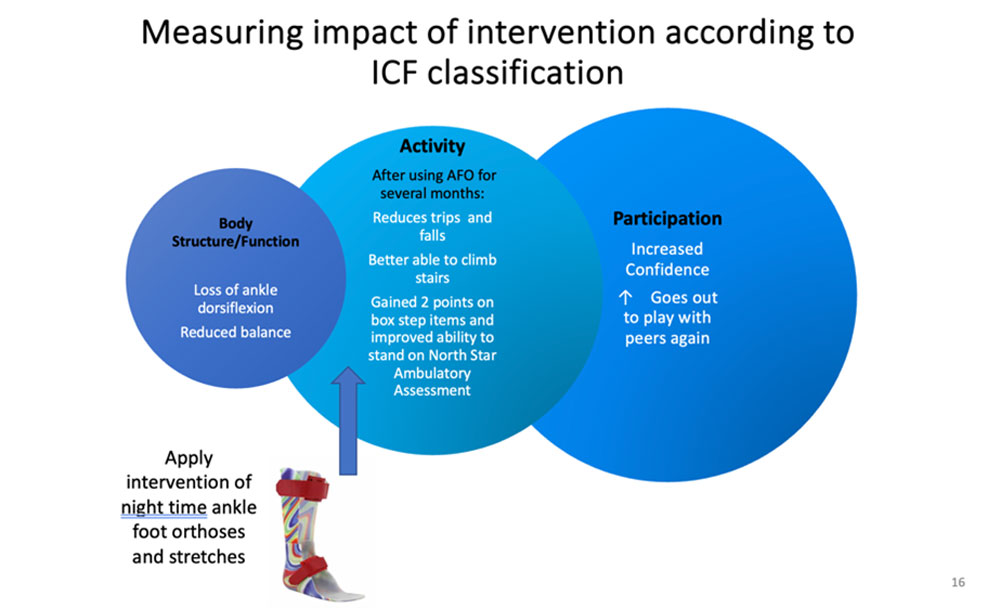
Assessments can be categorised according to the World Health Organisation International Classification of Functioning, Disability & Health Framework ​(WHO, 2001)​ of Body Functions & Structure: measures of muscle strength and weakness, posture, range of motion, respiratory function, pain and fatigue; Activities: measures of motor performance, gait, activities of daily living; Participation: Impact on home, work and social participation.

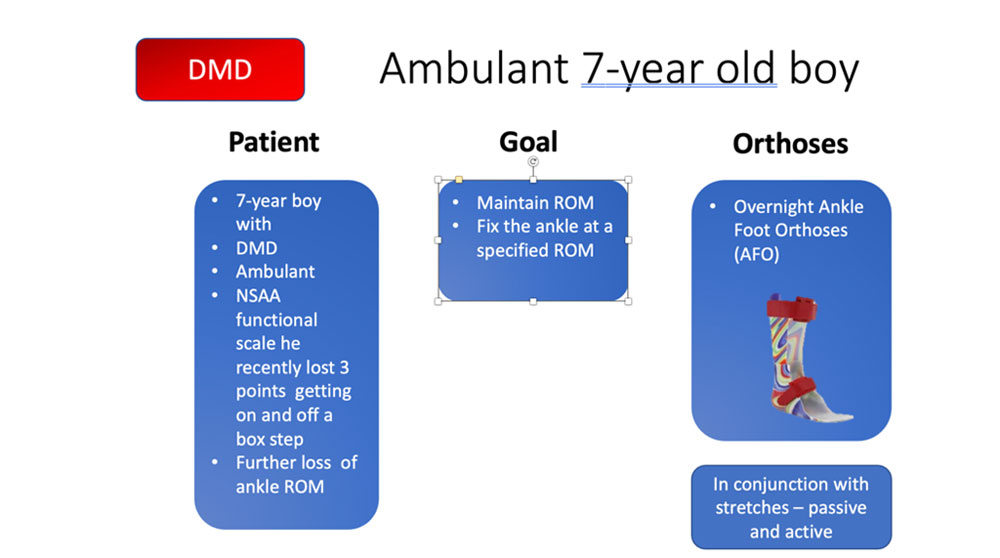
This structure can guide you to appropriate evaluation. For example, identifying a loss of range of motion in an ankle and loss of muscle strength (structure) has led to a loss of functional ability to walk normally (activities) which has impacted ability to walk during work and going out with friends (participation). Your management can then be driven by your clinical assessment and patient reported changes. See example button below.

Useful reference material regarding assessment of NMD in general as well as disease-specific assessments can be found in several key texts and documents.
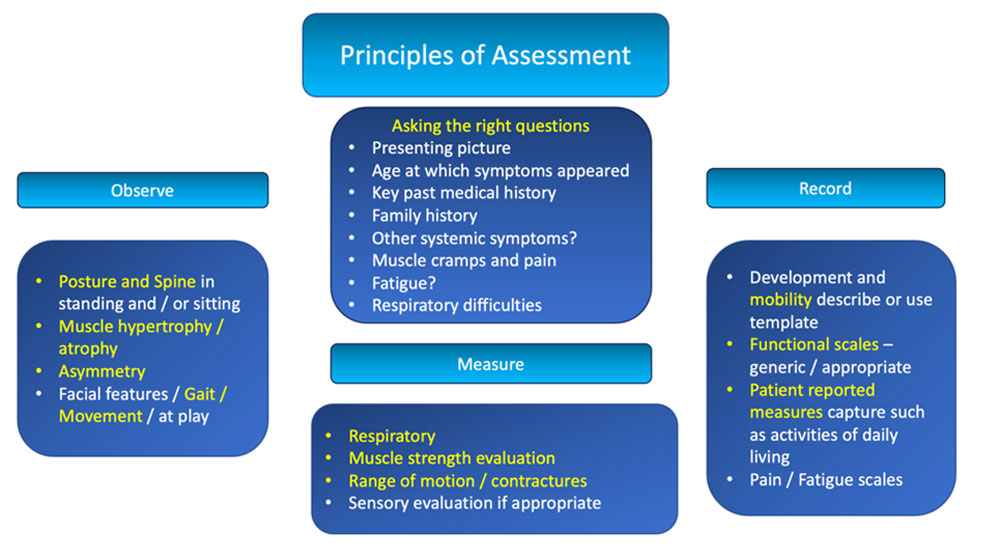
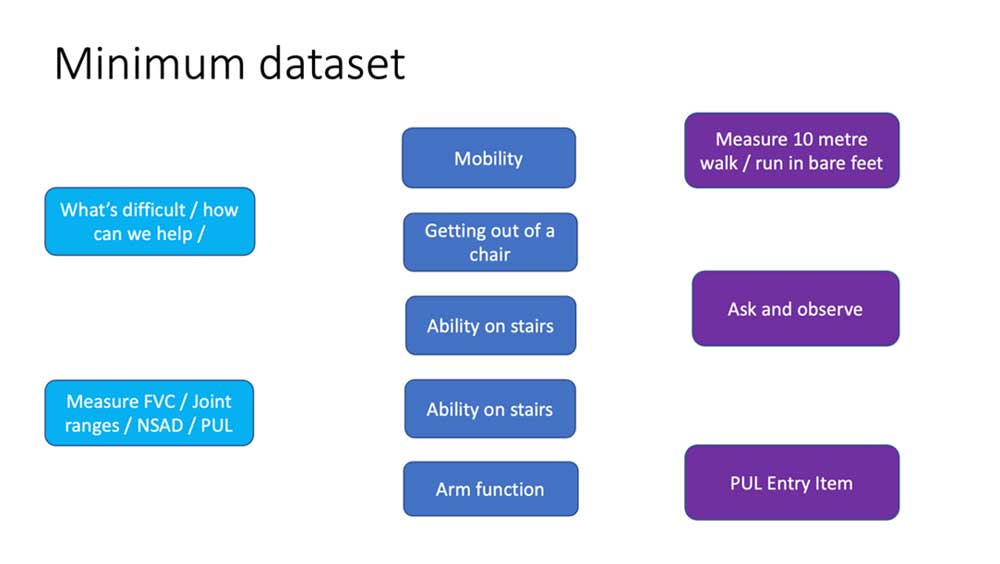
If you do not have a diagnosis:

  • In ambulant subjects start with a simple summary of function test, or if you have more time the NSAD.
  • If arm function is a particular issue, you could use the PUL entry item as a summary or the full PUL.
  • In non-ambulant individuals the EK2 scale can be a useful evaluation to guide management
  • To capture activities of daily living you could use the ACTIVLIM.
  • Additional assessments will depend on the issues raised by the individual and commonly include an assessment of respiratory function, range of motion, posture, and pain and activity as well as an all-important understanding of how they are managing at home.
Resources

Neuromuscular Disorders in Children A Multidisciplinary Approach to Management. 2019 Ed Nicolas Deconinick and Nathalie Goemans

NMD Adults Textbook guide coming soon!

Example of ICF classification in assessment & management:
Primary Sidebar

  • Becker Muscular Dystrophy (BMD)
    • Intro to BMD
    • Key Management: BMD
    • Key Assessment Guide: BMD
  • Congenital Muscular Dystrophy (CMD)
    • Intro to CMD
    • Key Management: CMD
    • Key Assessment Guide: CMD
  • Congenital Myasthenic Syndromes (CMS)
    • Intro to CMS
    • Key Management: CMS
    • Key Assessment Guide: CMS
  • Congenital Myopathies (CM)
    • Intro to CM
    • Key Management: CM
    • Key Assessment Guide: CM
  • Duchenne Muscular Dystrophy (DMD)
    • Intro to DMD
    • Key Management DMD
    • Key Assessment Guide: DMD
  • General Neuromuscular Diseases (NMD)
    • Intro to NMD
    • Key Management: NMD
    • Key Assessment Guide: NMD
  • Glycogen Storage (GS)
    • Intro to GSD
    • Key Management: GSD
    • Key Assessment Guide: GSD
  • Inherited Neuropathies
    • Intro to Inherited Neuropathies
    • Key Management: Inherited Neuropathies
    • Key Assessment Guide: Inherited Neuropathies
  • Limb Girdle Muscular Dystrophy (LGMD)
    • Intro to LGMD
    • Key Management: LGMD
    • Key Assessment Guide: LGMD
  • Myotonic Dystrophy (DM1)
    • Intro to DM1
    • Key Management: DM1
    • Key Assessment Guide: DM1
  • Spinal Muscular Atrophy (SMA)
    • Intro to SMA
    • Key Management: SMA
    • Key Assessment Guide: SMA

Footer

POD-NMD Logo

Links

Home
Who we are
Resources by condition
Assessment
Managing NMD
CPD Resources
Podcasts

Resources

POD-NMD LMS Login

Contact

Email: podnmd@treat-nmd.org

POD-NMD Privacy Policy POD-NMD LMS Privacy Policy Sitemap © POD-NMD 2026
  • Who We Are
    • Our Team & Governance
    • Partnerships & Collaborations
  • Resources by Condition
    • Becker Muscular Dystrophy (BMD)
      • Intro to BMD
    • Congenital Muscular Dystrophy (CMD)
      • Intro to CMD
      • Key Management: CMD
      • Key Assessment Guide: CMD
    • Congenital Myasthenia Syndrome (CMS)
      • Intro to CMS
      • Key Management: CMS
      • Key Assessment Guide: CMS
    • Congenital Myopathies (CM)
      • Intro to CM
      • Key Management: CM
      • Key Assessment Guide: CM
    • Duchenne Muscular Dystrophy (DMD)
      • Intro to DMD
      • Key Management: DMD
      • Key Assessment Guide: DMD
    • General Neuromuscular Diseases (NMD)
      • Intro to NMD
      • Key Management: NMD
      • Key Assessment Guide: NMD
    • Glycogen Storage (GSD)
      • Intro to GSD
      • Key Management: GSD
      • Key Assessment Guide: GSD
    • Inherited Neuropathies
      • Intro to Inherited Neuropathies
      • Key Management: Inherited Neuropathies
      • Key Assessment Guide: Inherited Neuropathies
    • Limb Girdle Muscular Dystrophy (LGMD)
      • Intro to LGMD
      • Key Management: LGMD
      • Key Assessment Guide: LGMD
    • Myotonic Dystrophy (DM1)
      • Intro to DM1
      • Key Management of DM1
      • Key Assessment Guide: DM1
    • Spinal Muscular Atrophy (SMA)
      • Intro to SMA
      • Key Management: SMA
      • Key Assessment Guide: SMA
  • Assessment
    • Motor Performance
      • NSAA
      • PUL 2.0
      • EK2
      • NSAD
      • RHS
      • HFMSE
      • RULM
      • ATEND
      • CHOP-INTEND
      • MFM
      • GMFM
      • TANS
      • CMS Specific Assessments
      • QMFT
      • GSGC
    • PROMS
      • ACTIVLIM
      • Egen Klassifikation
      • PROM-Upper
      • Myasthenia Gravis
      • Pompe R-PAct
      • Sleepiness
      • Satisfaction with Orthotic Provision
      • QOLgNMD
      • DMD-QoL
    • Timed Tests
      • Timed 10 Metre Walk/Run
      • Timed Rise From Floor
      • 6 Minute Walk Test
      • Timed Up & Go
      • 100 Metre Walk/Run Test
    • Additional Considerations
      • Respiratory Function
      • Pain
      • Posture & Spine
      • Strength
      • Quality of Life
      • Activity and Fatigue
      • Range of Motion
    • Assessing Babies and Young Children
      • Normal/Abnormal Development
      • Developmental Milestones
      • HINE
      • AIMS
      • BSID
      • CHOP-INTEND for Infants
    • Summary of Function Scales
      • Brooke Upper Extremity Grade
      • Vignos Lower Extremity Grade
      • DMDSAT
      • SOFT
  • Managing NMD
    • Staying Active & Stretches
      • Staying Active
      • Stretches
      • Jaw Tightness (Trismus)
      • Scoliosis Management
    • Managing Other Symptoms
      • Falls Management
      • Fatigue Management
      • Pain Management
      • Respiratory Management
      • Continence Care
      • Oedema Management
    • Multidisciplinary Care
      • Orthopaedic Management
      • Additional Multidisciplinary Management
      • Orthotics
      • Equipment Ideas
    • Occupational Therapy
      • Overview of Role
      • Home Adjustments
      • Mobility Aids and Wheelchairs
      • Support for Sitting
      • Mobile Arm Supports
      • Robotics
  • CPD Resources
  • Podcasts
    • Duchenne Muscular Dystrophy (DMD)
    • Inherited Neuropathies
    • Limb Girdle Muscular Dystrophy (LGMD)
    • Other
  • Search