• Skip to primary navigation
  • Skip to main content
  • Skip to primary sidebar
  • Skip to footer
POD-NMD Logo

Pod NMD

  • Who We Are
    • Our Team & Governance
    • Partnerships & Collaborations
  • Resources by Condition
    • Becker Muscular Dystrophy (BMD)
    • Congenital Muscular Dystrophy (CMD)
    • Congenital Myasthenia Syndrome (CMS)
    • Congenital Myopathies (CM)
    • Duchenne Muscular Dystrophy (DMD)
    • General Neuromuscular Diseases (NMD)
    • Glycogen Storage (GSD)
    • Inherited Neuropathies
    • Limb Girdle Muscular Dystrophy (LGMD)
    • Myotonic Dystrophy (DM1)
    • Spinal Muscular Atrophy (SMA)
  • Assessment
    • Motor Performance
    • PROMS
    • Timed Tests
    • Additional Considerations
    • Assessing Babies and Young Children
    • Summary of Function Scales
  • Managing NMD
    • Staying Active & Stretches
    • Managing Other Symptoms
    • Multidisciplinary Care
    • Occupational Therapy
  • CPD Resources
  • Podcasts
    • Duchenne Muscular Dystrophy (DMD)
    • Inherited Neuropathies
    • Limb Girdle Muscular Dystrophy (LGMD)
    • Other
  • Search

Key Management: NMD

/ Resources by Condition / Key Management: NMD

Key Management of General Neuromuscular Disorders

Managing General NMD

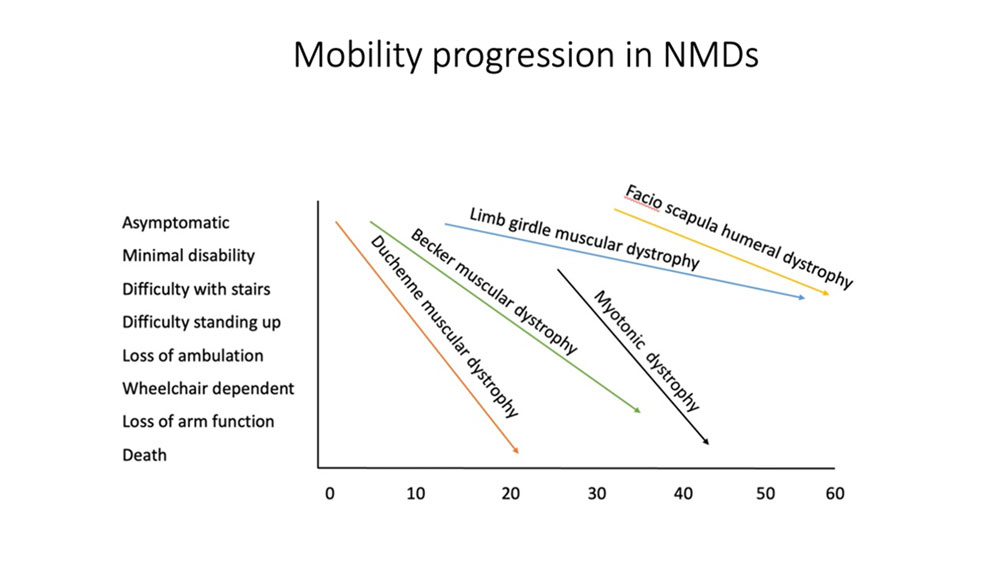
Key to successful management is a multidisciplinary approach involving rehabilitation, medical and potentially surgical management. Most management does not alter the natural course of NMD but manages decline and maximises independence throughout the life long course of the disease. Different neuromuscular disorders have different rates of progression, and this will be important to consider when planning and working with individuals. Care is a synthesis of expert opinion and the support from local and community services.
Provision of expert centres which pool multi-disciplinary expertise can assist in effective management. This can be time efficient as well as ensuring best practice is delivered in a field which is evolving rapidly. It is key that any central hub of expertise communicates effectively with local and community teams, so care is consistent and appropriate.

Care must be suitable regardless of the age of the individual and provided for their lifetime. It consists of a core of medical doctors and healthcare professionals from many different disciplines. This commonly includes physiotherapists, a respiratory team, cardiologists, surgeons, gastro enterologists, endocrinologists, geneticists, specialist nurses and ideally will also include access to psychological support, occupational therapy, speech and language therapy, social workers and if appropriate a palliative care team.

Principles of management 

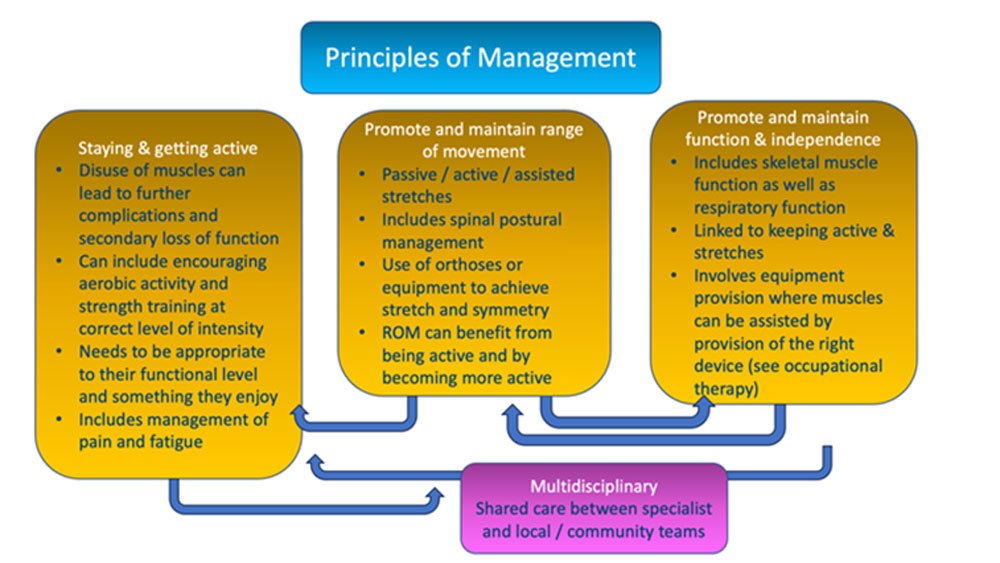
The key to management is working with your patient to promote and maintain function and independence with the intent to improve or maintain quality of life.

Key principles include:

  • Staying or getting active
  • Improving function and independence by:
    • Improving and maintaining range of movement
    • Appropriate use of orthotics and equipment including assistive devices
    • Managing pain and fatigue

The key is understanding how all these are interlinked. We know that the presence of pain can limit activity and function so by managing it, activity can be improved. We also know that activity can help manage pain. Improving range of movement can also encourage activity and activity in turn benefits range of movement.

Helping your patients understand the impact of disuse and providing ideas of how to break the cycle will be important. Some diseases will have very specific symptoms which will guide where you focus your management. Providing pacing advice for strong patients has its place alongside exploring the use of technology to support functional ability in someone who has lost all movements except isolated finger or even eye movements. Our role can be somewhat overwhelming; however, it is not necessarily complicated. Often our biggest hurdle is finding the right way to deliver management effectively with the necessary support.

Specialist services often do not provide therapy per se but provide therapy advice, and local services may not be supportive or even exist for our patients. Advocating for them is often a key part of what we do.

Education is another key principle of management. Educating families and individuals, giving appropriate advice and support to local teams, and ensuring this advice and support is communicated to everyone.
Resources

Below is a link to a patient-friendly: Evidence review of interventions for children with neuromuscular disorders. In this review they summarised the evidence on the effectiveness and safety of physical activity interventions on quality of life and activities of daily living in young people with progressive neuromuscular disorders.

  • PB NMD Interview of Interventions for children with NMD report
  • MDUK Education Guidelines for Physical Education
  • Adapting to life with a neuromuscular disease – Bridging Self Management

Primary Sidebar

  • Becker Muscular Dystrophy (BMD)
    • Intro to BMD
    • Key Management: BMD
    • Key Assessment Guide: BMD
  • Congenital Muscular Dystrophy (CMD)
    • Intro to CMD
    • Key Management: CMD
    • Key Assessment Guide: CMD
  • Congenital Myasthenic Syndromes (CMS)
    • Intro to CMS
    • Key Management: CMS
    • Key Assessment Guide: CMS
  • Congenital Myopathies (CM)
    • Intro to CM
    • Key Management: CM
    • Key Assessment Guide: CM
  • Duchenne Muscular Dystrophy (DMD)
    • Intro to DMD
    • Key Management DMD
    • Key Assessment Guide: DMD
  • General Neuromuscular Diseases (NMD)
    • Intro to NMD
    • Key Management: NMD
    • Key Assessment Guide: NMD
  • Glycogen Storage (GS)
    • Intro to GSD
    • Key Management: GSD
    • Key Assessment Guide: GSD
  • Inherited Neuropathies
    • Intro to Inherited Neuropathies
    • Key Management: Inherited Neuropathies
    • Key Assessment Guide: Inherited Neuropathies
  • Limb Girdle Muscular Dystrophy (LGMD)
    • Intro to LGMD
    • Key Management: LGMD
    • Key Assessment Guide: LGMD
  • Myotonic Dystrophy (DM1)
    • Intro to DM1
    • Key Management: DM1
    • Key Assessment Guide: DM1
  • Spinal Muscular Atrophy (SMA)
    • Intro to SMA
    • Key Management: SMA
    • Key Assessment Guide: SMA

Footer

POD-NMD Logo

Links

Home
Who we are
Resources by condition
Assessment
Managing NMD
CPD Resources
Podcasts

Resources

POD-NMD LMS Login

Contact

Email: podnmd@treat-nmd.org

POD-NMD Privacy Policy POD-NMD LMS Privacy Policy Sitemap © POD-NMD 2026
  • Who We Are
    • Our Team & Governance
    • Partnerships & Collaborations
  • Resources by Condition
    • Becker Muscular Dystrophy (BMD)
      • Intro to BMD
    • Congenital Muscular Dystrophy (CMD)
      • Intro to CMD
      • Key Management: CMD
      • Key Assessment Guide: CMD
    • Congenital Myasthenia Syndrome (CMS)
      • Intro to CMS
      • Key Management: CMS
      • Key Assessment Guide: CMS
    • Congenital Myopathies (CM)
      • Intro to CM
      • Key Management: CM
      • Key Assessment Guide: CM
    • Duchenne Muscular Dystrophy (DMD)
      • Intro to DMD
      • Key Management: DMD
      • Key Assessment Guide: DMD
    • General Neuromuscular Diseases (NMD)
      • Intro to NMD
      • Key Management: NMD
      • Key Assessment Guide: NMD
    • Glycogen Storage (GSD)
      • Intro to GSD
      • Key Management: GSD
      • Key Assessment Guide: GSD
    • Inherited Neuropathies
      • Intro to Inherited Neuropathies
      • Key Management: Inherited Neuropathies
      • Key Assessment Guide: Inherited Neuropathies
    • Limb Girdle Muscular Dystrophy (LGMD)
      • Intro to LGMD
      • Key Management: LGMD
      • Key Assessment Guide: LGMD
    • Myotonic Dystrophy (DM1)
      • Intro to DM1
      • Key Management of DM1
      • Key Assessment Guide: DM1
    • Spinal Muscular Atrophy (SMA)
      • Intro to SMA
      • Key Management: SMA
      • Key Assessment Guide: SMA
  • Assessment
    • Motor Performance
      • NSAA
      • PUL 2.0
      • EK2
      • NSAD
      • RHS
      • HFMSE
      • RULM
      • ATEND
      • CHOP-INTEND
      • MFM
      • GMFM
      • TANS
      • CMS Specific Assessments
      • QMFT
      • GSGC
    • PROMS
      • ACTIVLIM
      • Egen Klassifikation
      • PROM-Upper
      • Myasthenia Gravis
      • Pompe R-PAct
      • Sleepiness
      • Satisfaction with Orthotic Provision
      • QOLgNMD
      • DMD-QoL
    • Timed Tests
      • Timed 10 Metre Walk/Run
      • Timed Rise From Floor
      • 6 Minute Walk Test
      • Timed Up & Go
      • 100 Metre Walk/Run Test
    • Additional Considerations
      • Respiratory Function
      • Pain
      • Posture & Spine
      • Strength
      • Quality of Life
      • Activity and Fatigue
      • Range of Motion
    • Assessing Babies and Young Children
      • Normal/Abnormal Development
      • Developmental Milestones
      • HINE
      • AIMS
      • BSID
      • CHOP-INTEND for Infants
    • Summary of Function Scales
      • Brooke Upper Extremity Grade
      • Vignos Lower Extremity Grade
      • DMDSAT
      • SOFT
  • Managing NMD
    • Staying Active & Stretches
      • Staying Active
      • Stretches
      • Jaw Tightness (Trismus)
      • Scoliosis Management
    • Managing Other Symptoms
      • Falls Management
      • Fatigue Management
      • Pain Management
      • Respiratory Management
      • Continence Care
      • Oedema Management
    • Multidisciplinary Care
      • Orthopaedic Management
      • Additional Multidisciplinary Management
      • Orthotics
      • Equipment Ideas
    • Occupational Therapy
      • Overview of Role
      • Home Adjustments
      • Mobility Aids and Wheelchairs
      • Support for Sitting
      • Mobile Arm Supports
      • Robotics
  • CPD Resources
  • Podcasts
    • Duchenne Muscular Dystrophy (DMD)
    • Inherited Neuropathies
    • Limb Girdle Muscular Dystrophy (LGMD)
    • Other
  • Search