• Skip to primary navigation
  • Skip to main content
  • Skip to primary sidebar
  • Skip to footer
POD-NMD Logo

Pod NMD

  • Who We Are
    • Our Team & Governance
    • Partnerships & Collaborations
  • Resources by Condition
    • Becker Muscular Dystrophy (BMD)
    • Congenital Muscular Dystrophy (CMD)
    • Congenital Myasthenia Syndrome (CMS)
    • Congenital Myopathies (CM)
    • Duchenne Muscular Dystrophy (DMD)
    • General Neuromuscular Diseases (NMD)
    • Glycogen Storage (GSD)
    • Inherited Neuropathies
    • Limb Girdle Muscular Dystrophy (LGMD)
    • Myotonic Dystrophy (DM1)
    • Spinal Muscular Atrophy (SMA)
  • Assessment
    • Motor Performance
    • PROMS
    • Timed Tests
    • Additional Considerations
    • Assessing Babies and Young Children
    • Summary of Function Scales
  • Managing NMD
    • Staying Active & Stretches
    • Managing Other Symptoms
    • Multidisciplinary Care
    • Occupational Therapy
  • CPD Resources
  • Podcasts
    • Duchenne Muscular Dystrophy (DMD)
    • Inherited Neuropathies
    • Limb Girdle Muscular Dystrophy (LGMD)
    • Other
  • Search

Intro to NMD

/ Resources by Condition / Intro to NMD

Introduction to General Neuromuscular Disorders

What is a neuromuscular disorder?

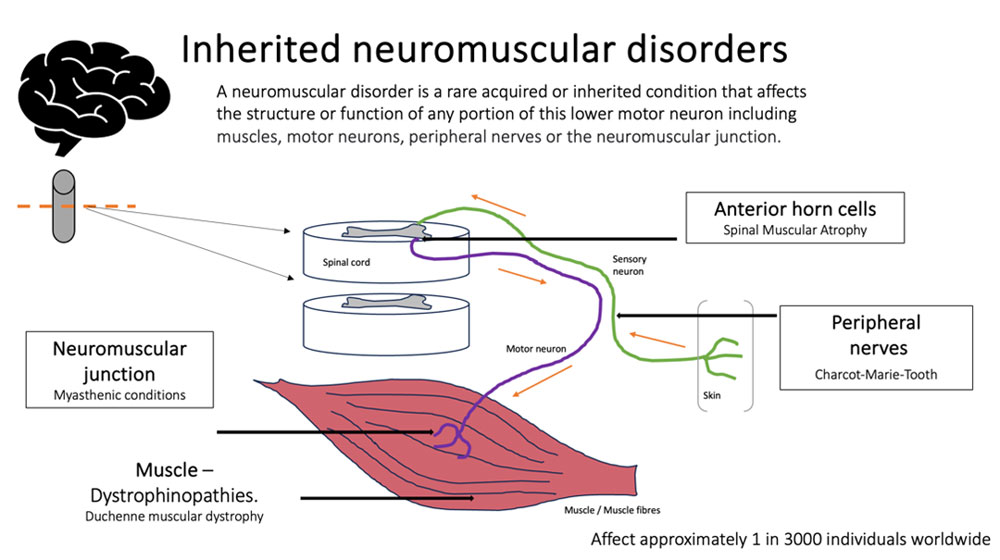
A neuromuscular disorder is a lower motor neuron lesion, affecting any portion of the neural pathway commencing at the anterior horn cells in the spine and ending at a motor end plate and the muscle. A neuromuscular disorder is a rare acquired or inherited condition that affects the structure or function of any portion of this lower motor neuron including muscles, motor neurons, peripheral nerves or the neuromuscular junction.

POD-NMD covers topics important to therapy management (physiotherapy and occupational therapy) for the more common forms of inherited neuromuscular disorders.

Diseases of the muscle 

Diseases of the muscle, dystrophinopathies, include Duchenne muscular dystrophy (DMD) and its milder phenotype, Becker muscular dystrophy (BMD), as well as limb girdle muscular dystrophies (LGMD). The most common anterior horn cell disease is spinal muscular atrophy (SMA) however, it is well-recognised that it is a more complex disease and other systems are affected. Diseases that affect the peripheral nerves include inherited motor sensory neuropathy or Charcot-Marie Tooth (CMT). Diseases that impact the neuromuscular junction include myasthenic conditions such as congenital myasthenia syndrome (CMS).

There are over 400 different types of neuromuscular disorders caused by over 1,000 different genetic mutations. There are no known cures for any neuromuscular disorder, although there are treatments now available and many therapeutic drugs in development.

For a physiotherapist, understanding the pathology of neuromuscular diseases can help explain the symptoms and difficulties experienced by people living with NMD.
Resources

Link to Neuromuscular Disease Center Website – useful and up to date information on all forms of NMD

Primary Sidebar

  • Becker Muscular Dystrophy (BMD)
    • Intro to BMD
    • Key Management: BMD
    • Key Assessment Guide: BMD
  • Congenital Muscular Dystrophy (CMD)
    • Intro to CMD
    • Key Management: CMD
    • Key Assessment Guide: CMD
  • Congenital Myasthenic Syndromes (CMS)
    • Intro to CMS
    • Key Management: CMS
    • Key Assessment Guide: CMS
  • Congenital Myopathies (CM)
    • Intro to CM
    • Key Management: CM
    • Key Assessment Guide: CM
  • Duchenne Muscular Dystrophy (DMD)
    • Intro to DMD
    • Key Management DMD
    • Key Assessment Guide: DMD
  • General Neuromuscular Diseases (NMD)
    • Intro to NMD
    • Key Management: NMD
    • Key Assessment Guide: NMD
  • Glycogen Storage (GS)
    • Intro to GSD
    • Key Management: GSD
    • Key Assessment Guide: GSD
  • Inherited Neuropathies
    • Intro to Inherited Neuropathies
    • Key Management: Inherited Neuropathies
    • Key Assessment Guide: Inherited Neuropathies
  • Limb Girdle Muscular Dystrophy (LGMD)
    • Intro to LGMD
    • Key Management: LGMD
    • Key Assessment Guide: LGMD
  • Myotonic Dystrophy (DM1)
    • Intro to DM1
    • Key Management: DM1
    • Key Assessment Guide: DM1
  • Spinal Muscular Atrophy (SMA)
    • Intro to SMA
    • Key Management: SMA
    • Key Assessment Guide: SMA

Footer

POD-NMD Logo

Links

Home
Who we are
Resources by condition
Assessment
Managing NMD
CPD Resources
Podcasts

Resources

POD-NMD LMS Login

Contact

Email: podnmd@treat-nmd.org

POD-NMD Privacy Policy POD-NMD LMS Privacy Policy Sitemap © POD-NMD 2026
  • Who We Are
    • Our Team & Governance
    • Partnerships & Collaborations
  • Resources by Condition
    • Becker Muscular Dystrophy (BMD)
      • Intro to BMD
    • Congenital Muscular Dystrophy (CMD)
      • Intro to CMD
      • Key Management: CMD
      • Key Assessment Guide: CMD
    • Congenital Myasthenia Syndrome (CMS)
      • Intro to CMS
      • Key Management: CMS
      • Key Assessment Guide: CMS
    • Congenital Myopathies (CM)
      • Intro to CM
      • Key Management: CM
      • Key Assessment Guide: CM
    • Duchenne Muscular Dystrophy (DMD)
      • Intro to DMD
      • Key Management: DMD
      • Key Assessment Guide: DMD
    • General Neuromuscular Diseases (NMD)
      • Intro to NMD
      • Key Management: NMD
      • Key Assessment Guide: NMD
    • Glycogen Storage (GSD)
      • Intro to GSD
      • Key Management: GSD
      • Key Assessment Guide: GSD
    • Inherited Neuropathies
      • Intro to Inherited Neuropathies
      • Key Management: Inherited Neuropathies
      • Key Assessment Guide: Inherited Neuropathies
    • Limb Girdle Muscular Dystrophy (LGMD)
      • Intro to LGMD
      • Key Management: LGMD
      • Key Assessment Guide: LGMD
    • Myotonic Dystrophy (DM1)
      • Intro to DM1
      • Key Management of DM1
      • Key Assessment Guide: DM1
    • Spinal Muscular Atrophy (SMA)
      • Intro to SMA
      • Key Management: SMA
      • Key Assessment Guide: SMA
  • Assessment
    • Motor Performance
      • NSAA
      • PUL 2.0
      • EK2
      • NSAD
      • RHS
      • HFMSE
      • RULM
      • ATEND
      • CHOP-INTEND
      • MFM
      • GMFM
      • TANS
      • CMS Specific Assessments
      • QMFT
      • GSGC
    • PROMS
      • ACTIVLIM
      • Egen Klassifikation
      • PROM-Upper
      • Myasthenia Gravis
      • Pompe R-PAct
      • Sleepiness
      • Satisfaction with Orthotic Provision
      • QOLgNMD
      • DMD-QoL
    • Timed Tests
      • Timed 10 Metre Walk/Run
      • Timed Rise From Floor
      • 6 Minute Walk Test
      • Timed Up & Go
      • 100 Metre Walk/Run Test
    • Additional Considerations
      • Respiratory Function
      • Pain
      • Posture & Spine
      • Strength
      • Quality of Life
      • Activity and Fatigue
      • Range of Motion
    • Assessing Babies and Young Children
      • Normal/Abnormal Development
      • Developmental Milestones
      • HINE
      • AIMS
      • BSID
      • CHOP-INTEND for Infants
    • Summary of Function Scales
      • Brooke Upper Extremity Grade
      • Vignos Lower Extremity Grade
      • DMDSAT
      • SOFT
  • Managing NMD
    • Staying Active & Stretches
      • Staying Active
      • Stretches
      • Jaw Tightness (Trismus)
      • Scoliosis Management
    • Managing Other Symptoms
      • Falls Management
      • Fatigue Management
      • Pain Management
      • Respiratory Management
      • Continence Care
      • Oedema Management
    • Multidisciplinary Care
      • Orthopaedic Management
      • Additional Multidisciplinary Management
      • Orthotics
      • Equipment Ideas
    • Occupational Therapy
      • Overview of Role
      • Home Adjustments
      • Mobility Aids and Wheelchairs
      • Support for Sitting
      • Mobile Arm Supports
      • Robotics
  • CPD Resources
  • Podcasts
    • Duchenne Muscular Dystrophy (DMD)
    • Inherited Neuropathies
    • Limb Girdle Muscular Dystrophy (LGMD)
    • Other
  • Search