
• Skip to primary navigation
  • Skip to main content
  • Skip to primary sidebar
  • Skip to footer
POD-NMD Logo

Pod NMD

  • Who We Are
    • Our Team & Governance
    • Partnerships & Collaborations
  • Resources by Condition
    • Becker Muscular Dystrophy (BMD)
    • Congenital Muscular Dystrophy (CMD)
    • Congenital Myasthenia Syndrome (CMS)
    • Congenital Myopathies (CM)
    • Duchenne Muscular Dystrophy (DMD)
    • General Neuromuscular Diseases (NMD)
    • Glycogen Storage (GSD)
    • Inherited Neuropathies
    • Limb Girdle Muscular Dystrophy (LGMD)
    • Myotonic Dystrophy (DM1)
    • Spinal Muscular Atrophy (SMA)
  • Assessment
    • Motor Performance
    • PROMS
    • Timed Tests
    • Additional Considerations
    • Assessing Babies and Young Children
    • Summary of Function Scales
  • Managing NMD
    • Staying Active & Stretches
    • Managing Other Symptoms
    • Multidisciplinary Care
    • Occupational Therapy
  • CPD Resources
  • Podcasts
    • Duchenne Muscular Dystrophy (DMD)
    • Inherited Neuropathies
    • Limb Girdle Muscular Dystrophy (LGMD)
    • Other
  • Search

Strength

/ Assessment / Strength

Strength Testing

Assessing for strength and weakness is often best conducted in the community by reviewing function and ability.
However, in specialist centres Manual Muscle Testing (MMT) can be conducted around diagnosis (and in the undiagnosed patient to help with diagnosis) and used to monitor progression. For example, knowledge of whether the knee extensor muscles can move fully, extend against gravity or not, can guide advice on walking aids and orthotics.
Myometry – which is a method of assessing muscle strength using a dynamometer – may be used to gain more objective values and to identify asymmetry in patients. As a tool this is primarily used in clinical trials and would not be suitable for community use.

General method for MMT

  1. Explain or demonstrate movement to the patient.
  2. Ask the patient to perform the movement in the antigravity position.
  3. If unable to then check patient’s understanding, ROM available, weakness.
  4. Based on the limiting factor(s) either instruct and demonstrate again, decide if ROM is affecting performance or repeat the test using antigravity position.
  5. Resistance is given through full available range.
  6. In the case of a contracture limiting ROM, grades are given as stated in table below, for available range. Range limitation should be noted in the comments section.
  7. If uncertain as to what grade should be given, the lower option should be chosen.
  8. If general compliance is such a problem that the results do not give, in the assessors considered opinion, a true indicator of the patient’s ability, then this should be noted, and the results should not be included in the database. If specific muscle groups are a problem e.g., due to pain, please note this and do not include in any calculation of the MRC %.
  9. Equipment –a height adjustable plinth should be available.
  10. Clothing – ideally shorts and t-shirt. If not shorts, then tracksuit bottoms. Jeans may restrict movement – especially in very weak children.
  11. Watch for compensatory movements being used to produce an action – if uncertain, palpate the muscle group which should be prime movers. Be clear with positioning and stabilisation.

Table 1 – MMT Grading system 
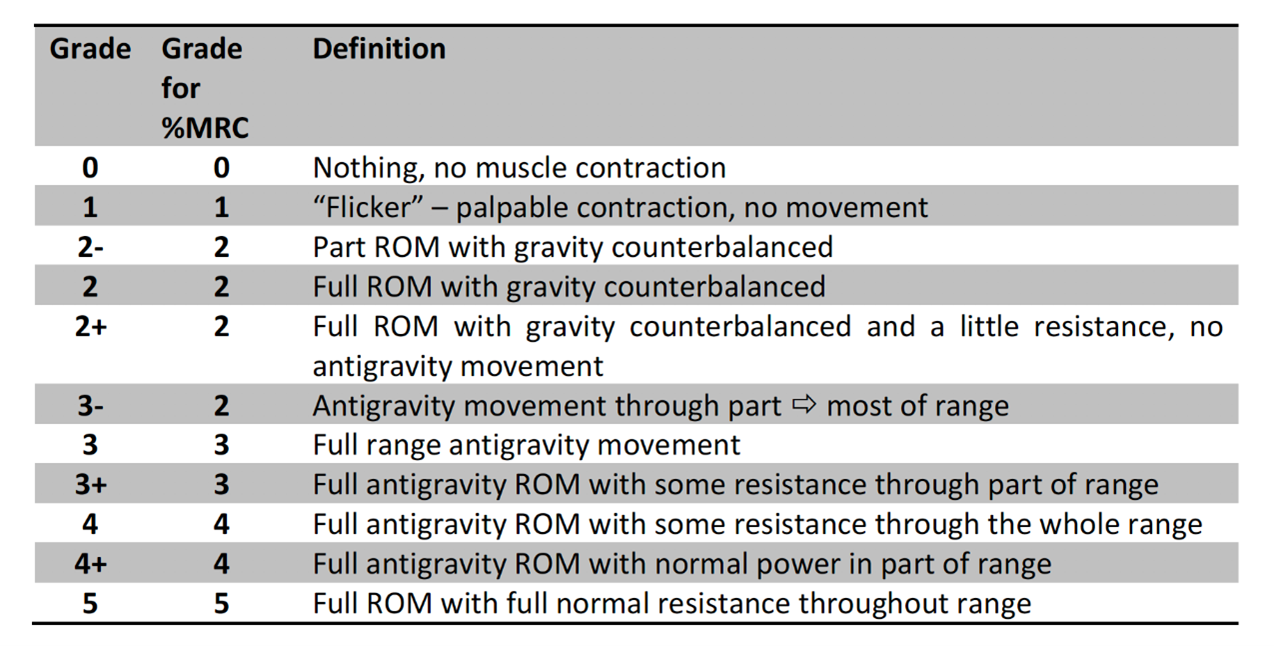
The above scale is based upon the modifications made to the original Medical Research Council 6- point scale by staff at the Hammersmith Hospital. Most physiotherapists who regularly use the muscle chart are familiar with this scale (or the expanded 16-point version).

A minus grade denotes loss of range. This is why 4- is not graded, as a grade of 4 is, by definition, full range.
The MRC percentage is to be calculated on the ‘whole’ score, rather than with the + and – grades. The ‘whole’ grades for each element of the scale are noted in column 2 of the above table.


Primary Sidebar

  • Assessment
  • Motor Performance Scales
    • ATEND
    • CHOP-INTEND
    • CMS Specific Assessments
    • EK2
    • GMFM
    • GSGC
    • HFMSE
    • MFM
    • NSAA
    • NSAD
    • PUL 2.0
    • QMFT
    • RHS
    • RULM
    • TANS
  • PROMS
    • ACTIVLIM
    • DMD-QoL
    • Egen Klassifikation
    • Myasthenia Gravis ADL
    • Pompe R-PAct
    • PROM-Upper
    • QOLgNMD
    • Satisfaction with Orthotic Provision
    • Sleepiness
  • Timed Tests
    • 6 Minute Walk Test
    • 100 Metre Walk/Run Test
    • GSGC Timed Tests
    • Timed 10 Metre Walk/Run
    • Timed Rise From Floor
    • Timed Up & Go
  • Additional Considerations
    • Activity and Fatigue
    • Good Clinical Practice
    • Height Measurement
    • Pain
    • Posture & Spine
    • Quality of Life
    • Range of Motion
    • Respiratory Function
    • Strength
  • Assessing Babies and Young children
    • AIMS
    • BSID
    • CHOP-INTEND for Infants
    • Developmental Milestones
    • HINE
    • Normal/Abnormal Development
  • Summary of Function Scales
    • Brooke Upper Extremity Grade
    • DMDSAT
    • SOFT
    • Vignos Lower Extremity Grade

Footer

POD-NMD Logo

Links

Home
Who we are
Resources by condition
Assessment
Managing NMD
CPD Resources
Podcasts

Resources

POD-NMD LMS Login

Contact

Email: podnmd@treat-nmd.org

POD-NMD Privacy Policy POD-NMD LMS Privacy Policy Sitemap © POD-NMD 2026
  • Who We Are
    • Our Team & Governance
    • Partnerships & Collaborations
  • Resources by Condition
    • Becker Muscular Dystrophy (BMD)
      • Intro to BMD
    • Congenital Muscular Dystrophy (CMD)
      • Intro to CMD
      • Key Management: CMD
      • Key Assessment Guide: CMD
    • Congenital Myasthenia Syndrome (CMS)
      • Intro to CMS
      • Key Management: CMS
      • Key Assessment Guide: CMS
    • Congenital Myopathies (CM)
      • Intro to CM
      • Key Management: CM
      • Key Assessment Guide: CM
    • Duchenne Muscular Dystrophy (DMD)
      • Intro to DMD
      • Key Management: DMD
      • Key Assessment Guide: DMD
    • General Neuromuscular Diseases (NMD)
      • Intro to NMD
      • Key Management: NMD
      • Key Assessment Guide: NMD
    • Glycogen Storage (GSD)
      • Intro to GSD
      • Key Management: GSD
      • Key Assessment Guide: GSD
    • Inherited Neuropathies
      • Intro to Inherited Neuropathies
      • Key Management: Inherited Neuropathies
      • Key Assessment Guide: Inherited Neuropathies
    • Limb Girdle Muscular Dystrophy (LGMD)
      • Intro to LGMD
      • Key Management: LGMD
      • Key Assessment Guide: LGMD
    • Myotonic Dystrophy (DM1)
      • Intro to DM1
      • Key Management of DM1
      • Key Assessment Guide: DM1
    • Spinal Muscular Atrophy (SMA)
      • Intro to SMA
      • Key Management: SMA
      • Key Assessment Guide: SMA
  • Assessment
    • Motor Performance
      • NSAA
      • PUL 2.0
      • EK2
      • NSAD
      • RHS
      • HFMSE
      • RULM
      • ATEND
      • CHOP-INTEND
      • MFM
      • GMFM
      • TANS
      • CMS Specific Assessments
      • QMFT
      • GSGC
    • PROMS
      • ACTIVLIM
      • Egen Klassifikation
      • PROM-Upper
      • Myasthenia Gravis
      • Pompe R-PAct
      • Sleepiness
      • Satisfaction with Orthotic Provision
      • QOLgNMD
      • DMD-QoL
    • Timed Tests
      • Timed 10 Metre Walk/Run
      • Timed Rise From Floor
      • 6 Minute Walk Test
      • Timed Up & Go
      • 100 Metre Walk/Run Test
    • Additional Considerations
      • Respiratory Function
      • Pain
      • Posture & Spine
      • Strength
      • Quality of Life
      • Activity and Fatigue
      • Range of Motion
    • Assessing Babies and Young Children
      • Normal/Abnormal Development
      • Developmental Milestones
      • HINE
      • AIMS
      • BSID
      • CHOP-INTEND for Infants
    • Summary of Function Scales
      • Brooke Upper Extremity Grade
      • Vignos Lower Extremity Grade
      • DMDSAT
      • SOFT
  • Managing NMD
    • Staying Active & Stretches
      • Staying Active
      • Stretches
      • Jaw Tightness (Trismus)
      • Scoliosis Management
    • Managing Other Symptoms
      • Falls Management
      • Fatigue Management
      • Pain Management
      • Respiratory Management
      • Continence Care
      • Oedema Management
    • Multidisciplinary Care
      • Orthopaedic Management
      • Additional Multidisciplinary Management
      • Orthotics
      • Equipment Ideas
    • Occupational Therapy
      • Overview of Role
      • Home Adjustments
      • Mobility Aids and Wheelchairs
      • Support for Sitting
      • Mobile Arm Supports
      • Robotics
  • CPD Resources
  • Podcasts
    • Duchenne Muscular Dystrophy (DMD)
    • Inherited Neuropathies
    • Limb Girdle Muscular Dystrophy (LGMD)
    • Other
  • Search