
Key Management of Duchenne Muscular Dystrophy
Management for children with neuromuscular conditions is constantly changing, with new developments in medication and therapeutic intervention. It is therefore essential to both read this information and seek out current information either from experts in the field or from additional websites and resources.
In a child or young man with Duchenne muscular dystrophy, the key is promoting and maintaining function for as long as possible and recognising that although new development milestones may be achieved in the early years, there comes a point where your role is to manage decline and maximise function. Keeping individuals active using appropriate types of aerobic activity / exercise is key to maintaining ‘good’ muscle. Low impact and symmetrical exercise aimed at increasing stamina, not power, are generally beneficial (e.g., cycling, swimming, hydrotherapy). Exercises that involve very repetitive eccentric muscle activity should be avoided. This includes running up and down stairs repeatedly and trampolining.
Sessions should be kept short and built up slowly. No guidelines exist for children, but Muscular Dystrophy UK’s Exercise Advice for adults may be helpful. It is important to think about activity in a wheelchair-dependent child or young adult. Wheelchair football and Boccia are good examples of accessible activities for those using wheelchairs or where ambulation is deteriorating.
Ambulatory Phase: Maintaining ambulation is the primary goal and boys should be encouraged to participate in PE and activity, especially low impact exercise such as swimming. Boys may not be able to keep up with their peers and participation may need to be limited to short periods and paced appropriately. Active trampolining, which involves significant impact and eccentric muscle activity, is strongly discouraged. Overuse of trampolining can lead to muscle damage resulting in myoglobinuria (Coca-Cola coloured urine). The use of scooters is also discouraged, as it is encouraging leg and hip power asymmetry. Children should try bicycles, tricycles or low gear tricycles. NB – low-geared tricycles are VERY expensive and may need charity funding. As boys become weaker you could consider the use of Knee-Ankle-Foot orthotics.
Progression to non-ambulatory phase: Managing a progressive condition such as this requires sensitivity and boys and families sometimes need to be given “permission to stop walking”. Ensure early referral for wheelchairs and offer appropriate advice. As steroids keep boys and young men ‘stronger for longer’, manual chairs with assisted power chairs or even sit-on scooters may be appropriate. Since steroids often significantly limit growth, be aware that not all wheelchairs that are wide enough, fit leg length appropriately. As the disease progresses extra support may be needed to limit hip abduction and we recommend avoiding sitting that uses pommels for this reason.
Provision of a powered wheelchair often gives back independence and allows the young people to use their energy to do other things. Participation in sport is still important and continuing swimming, wheelchair football or Boccia can be encouraged. It is important to advise and assist in obtaining appropriate mobility equipment at the relevant time, such as manual wheelchair to help with school trips etc. when a boy’s ability to walk for long distances may be reduced.
Early referral for home and school adaptations i.e., ramps, lifts, wet rooms, bathroom equipment is imperative. It is not unusual for major work to be required to future-proof any adaptations to incorporate tracking hoists etc. Sleeping and appropriate mattress and bed provision are also important and should be reviewed with the appropriate support from additional professionals. As arm function is lost, feeding may become difficult. Mobile arm supports may be beneficial.
- Age-appropriate exercise programmes and activity advice should be given, and PE encouraged.
- Using energy for fun things is important. Rather than using all their energy to walk to the park – save energy and have fun when you get to the park.
- Avoid eccentric muscle activities (e.g., trampolines) and asymmetrical activities (e.g., use of scooters).
- The Muscular Dystrophy UK Education Guidelines on Physical Education provides useful information on inclusion in PE at school.
Ambulatory Phase: Monitoring the spine even whilst boys and young men are ambulant is important and check that any developing kyphosis remains mobile. Lordosis is often very evident as ambulation becomes more difficult. This cannot be corrected but sometimes lumbar support can be useful if back pain is a problem.
Non-ambulatory phase: Key to spinal management during this phase is a good symmetrical sitting position with adequate thoracic support. It is important that the wheelchair is wide enough but not too wide, that the height of the arm rests is even on both sides and that at rest the elbows when on the armrests do not drag the shoulders down or push them up. Feet must be supported, and the position of the wheelchair control should be such that the boy remains in good posture whilst steering the wheelchair.
Ensure that other sitting positions used for the boy to relax in also promotes relative symmetry.
Use of sleep systems at night to encourage symmetry may be beneficial but are not always well tolerated.
Boys should be referred for an orthopaedic assessment if a scoliosis is apparent. Spinal bracing and surgical stabilisation are not used as frequently in Duchenne now, due to the advances in medical management and the fact that boys and young men are staying ambulant for longer. Boys who lose ambulation before reaching puberty are most likely to require intervention.
Ambulatory phase: The first strategy is usually daily stretches for tight joints. However, do not give a huge programme of stretches to families if joints are not tight. Dorsiflexion of the ankle is the main joint that needs attention and teach stretches for hips, knees and ITB if necessary, if weakness leads to contractures. In younger children these stretches are usually taught to families and carers and are passive in nature. However, active or self-directed stretches can be shown and are important for older boys. Remember a loss of range is not always due to a lack of physiotherapy, as growth or a sudden increase in strength when steroids are started can lead to a further loss of range.
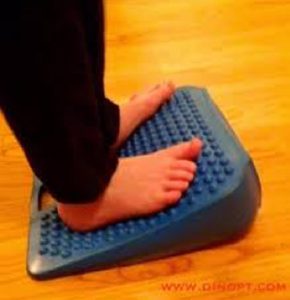
If stretches are not sufficient to maintain a reasonable joint range (10 degrees ankle DF) orthotics or serial casts can be used.
Night-time AFO’s are commonly prescribed for ambulatory boys. However daytime AFO’s are NOT beneficial and should not be used. Insoles can be useful, and some centres use contracture control devices (CCD) for ankles in this group.
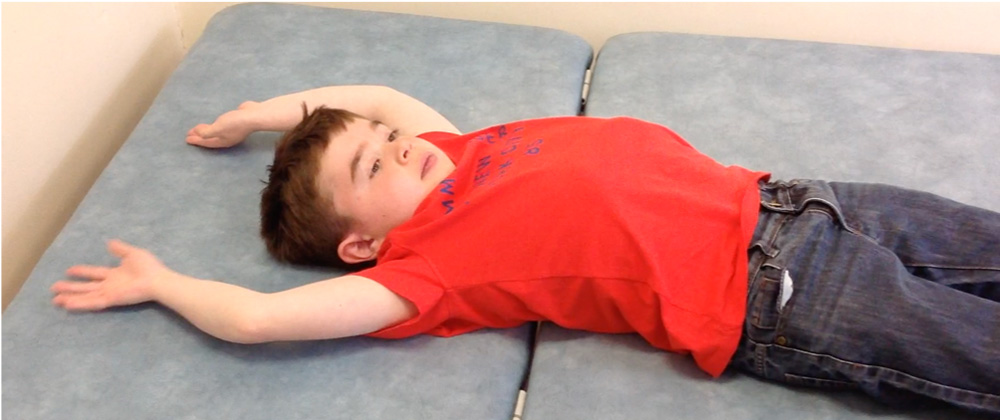
Strong boys or young men who spend a long time in a wheelchair in a flexed position may benefit from stretches to the back to promote extension. Positioned supine on a bed without a pillow, have them place their arms as high as they can above their head as in the photograph.
Non-ambulatory: Daytime AFO’s can be important to maintain good foot position but are sometimes poorly tolerated and poorly understood by the boys. As fixed plantar flexion progresses, they tend towards inversion, which can be painful and can make it difficult to find footwear that fits. Prevention is preferable to the need for surgery in the future. Surgery may be considered earlier rather than later particularly in boys with splint compliance issues – to ensure that deteriorating cardiac and respiratory function do not prevent surgery.
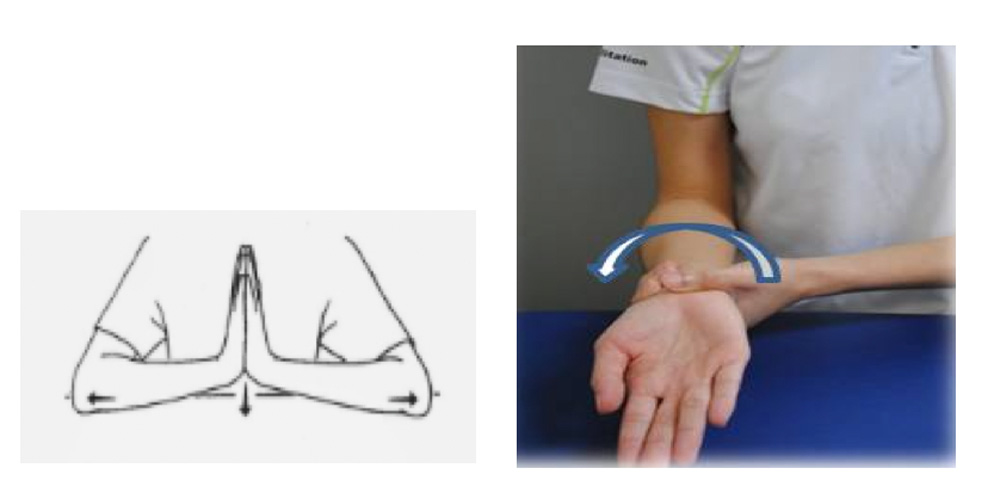
In both the ambulatory and non-ambulatory phase long finger flexor tightness and reduced range of supination can occur (especially if they spend a lot of time using technology). Simple stretches can help improve range of movement.
Long bone fractures are commonly femur and spiral fractures of the fibula. The main causes are falls or slips whilst walking or whilst transferring. Long bone fractures are not always associated with severe pain, but you should get an x-ray as soon as possible.
Long bone fracture management of the femur needs internal fixation by an orthopaedic surgeon. Contact a specialist muscle centre to arrange transfer for surgery – anaesthetists are happy to gas a complex case at these centres. Patients will usually receive painkillers and a loading dose of steroids. Be sure to provide clear guidelines for post-op mobilisation and help to promote good ankle position.
Long bone fracture management of the fibula can present as an ankle sprain and may not be that painful. It can be managed in an orthopaedic boot.
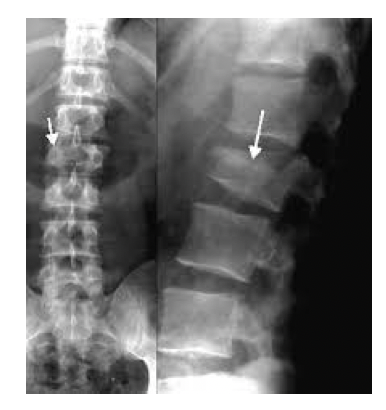
A vertebral fracture may be related to a specific event, either a lift or perhaps a fall, but it is not always clear from the family or the individual if it was a specific event that caused the fracture.
It is not uncommon for the pain to not be severe and can be completely absent as a symptom of a fracture. An X-ray is key following a fall or slip and should be recommended after a fall even if the boy or young man is not in pain.
Management is often conservative and should consist of pain relief, possible some lumbar support and gentle mobilisation. It is important to review lifting and handling procedures and techniques with the family and carers to ensure this is not a source of additional stress to the spine. If the individual is not in discomfort, it is OK to continue with standing (in a frame or out of it), hydrotherapy etc.
- SMN – Ankle Management in Duchenne Muscular Dystrophy – Patient Booklet. This document is available courtesy of Marina Di Marco and the Scottish Muscle Network
- POD-NMD LMS Video: Manual Wheelchair -Assessing young boy in wheelchair
- POD-NMD LMS Video: Hydrotherapy
- YouTube Video: Calf Muscle Stretch
- YouTube Video: Standing Wedge Stretch
- YouTube Video: Hip Flexor Stretch
- YouTube Video: IT Band Stretch
- YouTube Video: Knee & Hamstring Stretch
- YouTube Video: Wrist, Elbow, Hand Stretch
- YouTube Video: Wrist & Hand Stretch
DMD Care UK: Respiratory Care Guide
Parent Project Muscular Dystrophy: Assistive Devices for Breathing Guide
Article on the: Development of Respiratory Care Guidelines for Duchenne Muscular Dystrophy in the UK: Key Recommendations for Clinical Practice. thorax-2023-220811.full
Resources
These international publications can be used by doctors, patients and families worldwide as a guide to the treatment that individuals with Duchenne should receive at each stage of the disease. The guidelines are based on international consensus including both the medical and the patient advocacy perspectives. Part 1 and 2 are most useful for physiotherapists.