
• Skip to primary navigation
  • Skip to main content
  • Skip to primary sidebar
  • Skip to footer
POD-NMD Logo

Pod NMD

  • Who We Are
    • Our Team & Governance
    • Partnerships & Collaborations
  • Resources by Condition
    • Becker Muscular Dystrophy (BMD)
    • Congenital Muscular Dystrophy (CMD)
    • Congenital Myasthenia Syndrome (CMS)
    • Congenital Myopathies (CM)
    • Duchenne Muscular Dystrophy (DMD)
    • General Neuromuscular Diseases (NMD)
    • Glycogen Storage (GSD)
    • Inherited Neuropathies
    • Limb Girdle Muscular Dystrophy (LGMD)
    • Myotonic Dystrophy (DM1)
    • Spinal Muscular Atrophy (SMA)
  • Assessment
    • Motor Performance
    • PROMS
    • Timed Tests
    • Additional Considerations
    • Assessing Babies and Young Children
    • Summary of Function Scales
  • Managing NMD
    • Staying Active & Stretches
    • Managing Other Symptoms
    • Multidisciplinary Care
    • Occupational Therapy
  • CPD Resources
  • Podcasts
    • Duchenne Muscular Dystrophy (DMD)
    • Inherited Neuropathies
    • Limb Girdle Muscular Dystrophy (LGMD)
    • Other
  • Search

Pain

/ Assessment / Pain

Pain

It is important to capture pain and associated symptoms for subjects experience significant pain as many NMD are associated with significant chronic pain. Of course, they may not use one word to describe this pain, and this can be a helpful way to identify the aetiology. You can use a simple body chart to document pain or a Visual Analogue Scale.
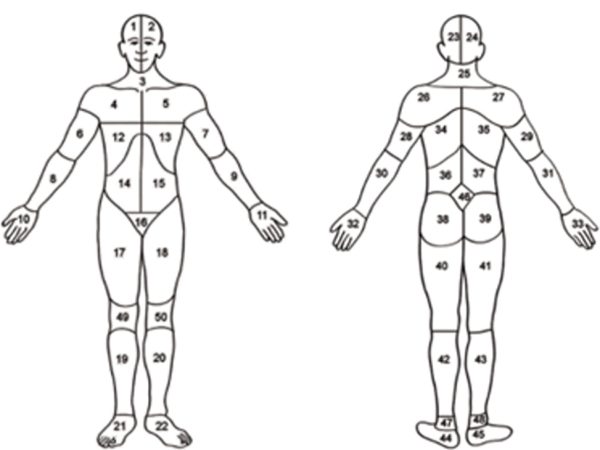
2-3-Pain-Visual-Analogue-Scale-Body-Chart

Visual Analogue Scale

A Visual Analogue Scale (VAS) is an instrument for subjective rating of pain. The pain VAS is most often used as a unidimensional measure of pain intensity.

The VAS is a straight horizontal line of fixed length, usually 100 mm. The ends are defined as the extreme limits of the parameter to be measured, hence the left end is usually labelled ‘no pain’, and the right end ‘extreme pain’ or (as with the NPRS) some other verbal anchor. Scales can also be used vertically but are no more reliable.

Using a ruler, the score is determined by measuring the distance (mm) on the 10-cm line between the “no pain” anchor and the patient’s mark, providing a range of scores from 0–100. As with the NPRS, categories may be imposed on this (no pain 0–4 mm; mild pain 5-44 mm; moderate pain 45–74 mm; severe pain 75–100 mm) but this is arbitrary and does not necessarily reflect patients’ meanings.
Copyright: None
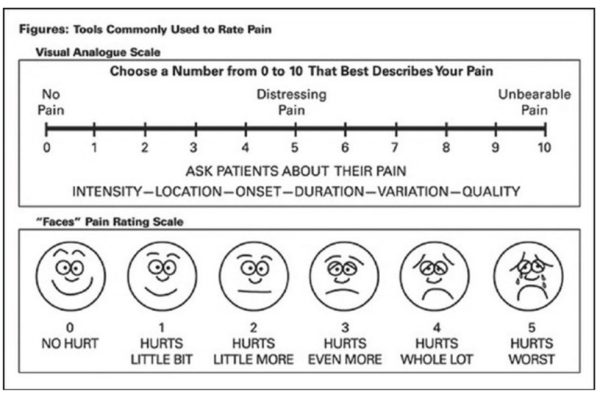
2-3-Pain-visual-analogue-scale-faces

Verbal Rating Scale (VRS)

The Verbal Rating Scale consists of a list of adjectives describing different levels of pain intensity. Patients are asked to select the adjective that best represents their pain. This should reflect the extremes of this dimension; from ‘no pain’ to ‘extremely intense pain’ and sufficient intervening adjectives to capture gradations of pain intensity that may be experienced between extremes.

  • no pain = 0
  • mild pain = 1
  • moderate pain = 2
  • severe pain = 3
  • very severe pain = 4

VRSs are scored as above but these are ranks, not equal intervals.
This article provides further information on the: Assessment of pain and health-related quality of life in slowly progressive neuromuscular disease – Abresch 2002


Back Pain

Primary Sidebar

  • Assessment
  • Motor Performance Scales
    • ATEND
    • CHOP-INTEND
    • CMS Specific Assessments
    • EK2
    • GMFM
    • GSGC
    • HFMSE
    • MFM
    • NSAA
    • NSAD
    • PUL 2.0
    • QMFT
    • RHS
    • RULM
    • TANS
  • PROMS
    • ACTIVLIM
    • DMD-QoL
    • Egen Klassifikation
    • Myasthenia Gravis ADL
    • Pompe R-PAct
    • PROM-Upper
    • QOLgNMD
    • Satisfaction with Orthotic Provision
    • Sleepiness
  • Timed Tests
    • 6 Minute Walk Test
    • 100 Metre Walk/Run Test
    • GSGC Timed Tests
    • Timed 10 Metre Walk/Run
    • Timed Rise From Floor
    • Timed Up & Go
  • Additional Considerations
    • Activity and Fatigue
    • Good Clinical Practice
    • Height Measurement
    • Pain
    • Posture & Spine
    • Quality of Life
    • Range of Motion
    • Respiratory Function
    • Strength
  • Assessing Babies and Young children
    • AIMS
    • BSID
    • CHOP-INTEND for Infants
    • Developmental Milestones
    • HINE
    • Normal/Abnormal Development
  • Summary of Function Scales
    • Brooke Upper Extremity Grade
    • DMDSAT
    • SOFT
    • Vignos Lower Extremity Grade

Footer

POD-NMD Logo

Links

Home
Who we are
Resources by condition
Assessment
Managing NMD
CPD Resources
Podcasts

Resources

POD-NMD LMS Login

Contact

Email: podnmd@treat-nmd.org

POD-NMD Privacy Policy POD-NMD LMS Privacy Policy Sitemap © POD-NMD 2026
  • Who We Are
    • Our Team & Governance
    • Partnerships & Collaborations
  • Resources by Condition
    • Becker Muscular Dystrophy (BMD)
      • Intro to BMD
    • Congenital Muscular Dystrophy (CMD)
      • Intro to CMD
      • Key Management: CMD
      • Key Assessment Guide: CMD
    • Congenital Myasthenia Syndrome (CMS)
      • Intro to CMS
      • Key Management: CMS
      • Key Assessment Guide: CMS
    • Congenital Myopathies (CM)
      • Intro to CM
      • Key Management: CM
      • Key Assessment Guide: CM
    • Duchenne Muscular Dystrophy (DMD)
      • Intro to DMD
      • Key Management: DMD
      • Key Assessment Guide: DMD
    • General Neuromuscular Diseases (NMD)
      • Intro to NMD
      • Key Management: NMD
      • Key Assessment Guide: NMD
    • Glycogen Storage (GSD)
      • Intro to GSD
      • Key Management: GSD
      • Key Assessment Guide: GSD
    • Inherited Neuropathies
      • Intro to Inherited Neuropathies
      • Key Management: Inherited Neuropathies
      • Key Assessment Guide: Inherited Neuropathies
    • Limb Girdle Muscular Dystrophy (LGMD)
      • Intro to LGMD
      • Key Management: LGMD
      • Key Assessment Guide: LGMD
    • Myotonic Dystrophy (DM1)
      • Intro to DM1
      • Key Management of DM1
      • Key Assessment Guide: DM1
    • Spinal Muscular Atrophy (SMA)
      • Intro to SMA
      • Key Management: SMA
      • Key Assessment Guide: SMA
  • Assessment
    • Motor Performance
      • NSAA
      • PUL 2.0
      • EK2
      • NSAD
      • RHS
      • HFMSE
      • RULM
      • ATEND
      • CHOP-INTEND
      • MFM
      • GMFM
      • TANS
      • CMS Specific Assessments
      • QMFT
      • GSGC
    • PROMS
      • ACTIVLIM
      • Egen Klassifikation
      • PROM-Upper
      • Myasthenia Gravis
      • Pompe R-PAct
      • Sleepiness
      • Satisfaction with Orthotic Provision
      • QOLgNMD
      • DMD-QoL
    • Timed Tests
      • Timed 10 Metre Walk/Run
      • Timed Rise From Floor
      • 6 Minute Walk Test
      • Timed Up & Go
      • 100 Metre Walk/Run Test
    • Additional Considerations
      • Respiratory Function
      • Pain
      • Posture & Spine
      • Strength
      • Quality of Life
      • Activity and Fatigue
      • Range of Motion
    • Assessing Babies and Young Children
      • Normal/Abnormal Development
      • Developmental Milestones
      • HINE
      • AIMS
      • BSID
      • CHOP-INTEND for Infants
    • Summary of Function Scales
      • Brooke Upper Extremity Grade
      • Vignos Lower Extremity Grade
      • DMDSAT
      • SOFT
  • Managing NMD
    • Staying Active & Stretches
      • Staying Active
      • Stretches
      • Jaw Tightness (Trismus)
      • Scoliosis Management
    • Managing Other Symptoms
      • Falls Management
      • Fatigue Management
      • Pain Management
      • Respiratory Management
      • Continence Care
      • Oedema Management
    • Multidisciplinary Care
      • Orthopaedic Management
      • Additional Multidisciplinary Management
      • Orthotics
      • Equipment Ideas
    • Occupational Therapy
      • Overview of Role
      • Home Adjustments
      • Mobility Aids and Wheelchairs
      • Support for Sitting
      • Mobile Arm Supports
      • Robotics
  • CPD Resources
  • Podcasts
    • Duchenne Muscular Dystrophy (DMD)
    • Inherited Neuropathies
    • Limb Girdle Muscular Dystrophy (LGMD)
    • Other
  • Search