Key Assessment Guide for Duchenne Muscular Dystrophy
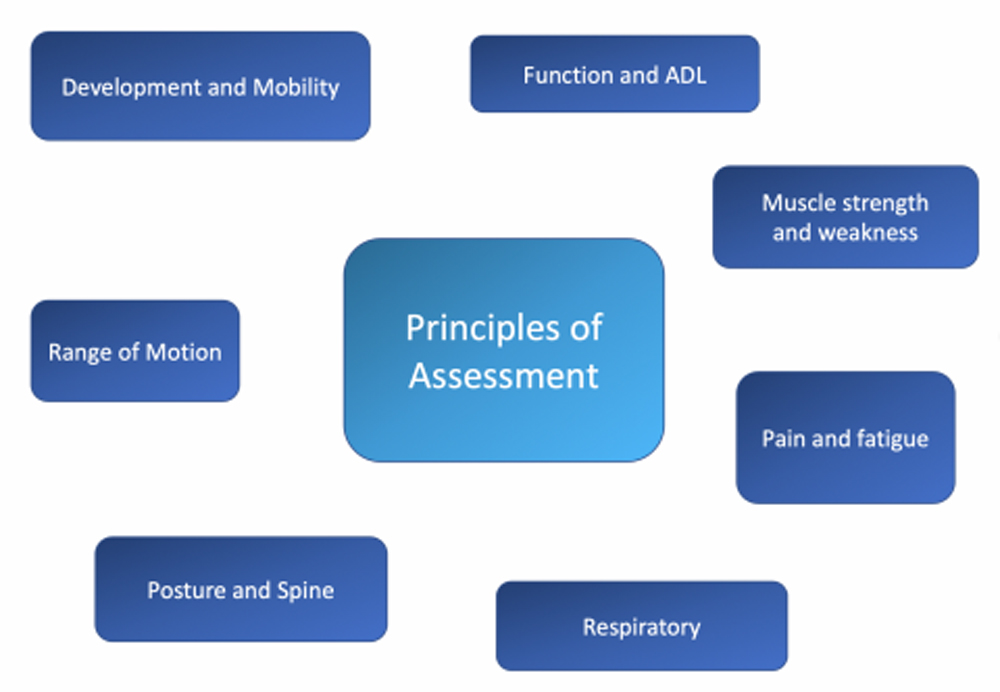
Principles of Assessment for DMD
You can use all your usual skills of observation and assessment when assessing young DMD boys. You do not need to use disease-specific complex scales, but you do need to identify areas where you can help. Knowing how to identify normal and abnormal development is key.
As they get older there are several suitable and disease-specific scales which you can use – see below.
An Early Diagnosis Video is available for therapists to watch on POD-NMD LMS.
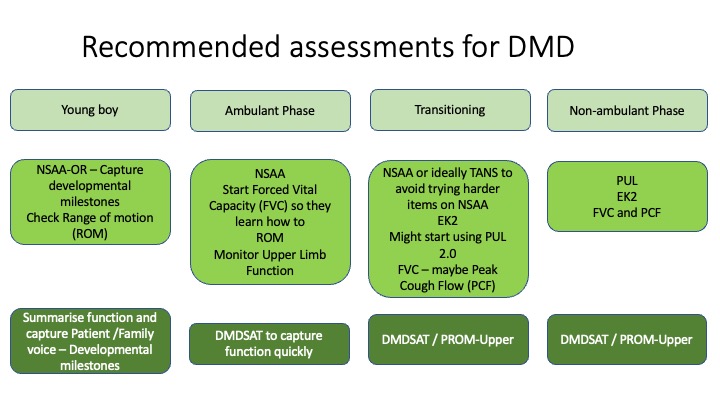
The non-ambulant phase in DMD is often a long one and will usually occur over time rather than from one day to the next. It may be regained (for example after a long bone fracture) and an individual may remain able to stand for quite some time after they have lost the ability to walk.
It can be defined in various ways:
- Clinicians often define non-ambulant as unable to walk 10 metres independently (as in item 17 of the NSAA)
- Families may well see things differently. An individual we consider non-ambulant may still move about his home independently either using steps or cruising on furniture, and he and his family consider this as ambulatory.
- It can also be defined as how much a wheelchair is used by the individual, a part-time or full-time wheelchair user. Some individuals may use a manual wheelchair rather than a powered one or use a scooter for travelling distances. So, there are shades of ambulatory ability and care must be taken that professionals and families are clear what is meant by the term.
In summary, the non-ambulant phase often occurs gradually and can be a very stable phase for many years where trunk and arm function are well-preserved. Function may be lost in small increments and every effort must be made to preserve function and independence, often with the use of assistive technology. It is also a time where respiratory and cardiac function can be more evident, and these must be monitored closely in this phase.
The point at which a boy or young man becomes non-ambulant is not always distinct but there comes a point where he can no longer walk and spends most of the day in a wheelchair. This can be a positive time for the individual as he regains independence in an electric wheelchair and no longer worries about falls or doing activities that he finds very difficult. He may well transfer by weight bearing and may spend time in a standing frame. Not all the people around a young man may feel as positive about this transition and it can take time for everyone to adapt.
Assessment at this stage is about mobility, transfers, spine, trunk and arm function. Respiratory monitoring is also very important and is also covered in the Managing NMD section.
Mobility: It is key to understand how a child or young man mobilises, when he uses a wheelchair and what type, and if the wheelchair is adequate for the task.
Transfers: In the early stages of loss of ambulation, it is important to promote active, yet safe, transfers. However, hoisting should be introduced sooner rather than later to avoid injury to the child or the parent / carer. The risk of fractures is greater in this population due to the long-term use of systemic steroids so even a small fall or slip may lead to a fracture or injury.
Spine: It is especially important to assess spinal posture if ambulation is lost before the boy has stopped growing. The mobility and form of the spine should be reviewed for scoliosis and curvatures. A scoliosis should be discussed with the medical team and if necessary, a referral made for spinal x-ray and to the orthopaedic team for review and monitoring. Those boys who still lose ambulation early can have a rapidly progressing spinal scoliosis. Management should include promoting symmetrical posture, providing adequate trunk support and reviewing the position of the control on an electric wheelchair, because this may influence the symmetry of a sitting posture.
Trunk and arm function: A simple measure of arm performance can be the modified Brooke scale. For a more detailed assessment of arm function the Performance of Upper Limb Scale may be used. A patient reported measure such as the Egan Klassifikation Scale can also help direct you to management strategies for particular issues including some trunk weakness.
- Developmental milestones can be assessed using any of your usual tools (Alberta Infant Motor Scale (AIMS) etc)
- Gross motor function measure (GMFM) domains can also be used. Asymmetry is not a large feature of Duchenne muscular dystrophy, but differences may be apparent.
- Ambulatory status, note ability indoors as well as outdoors and distance walked (can ask how far when the way is flat or if there is a slope)
- Wheelchair use – especially occasional use, as pain and weakness can impact on mobility.
- Gait, transfers and ability on stairs can be assessed.
- Symptoms of fatigue may also need to be assessed especially in the non-ambulant phase.
- Timed tests for ambulant boys and young men can be useful, including:
- Rise from floor time – supine to standing.
- 10 metre run / walk
- These tests are included in the NSAA.
Loss of ankle range commonly occurs. Restricted dorsiflexion may appear to be more dynamic (up on toes whilst walking) or observed as passive loss of range. Other commonly affected joint ranges are hip extension (often evident as a lack of extension when walking), tight ITB’s and as ambulation becomes more difficult or is lost, range may be lost in knee extension. Even whilst the boy or young man is walking, the upper limbs may also be affected particularly long finger flexors and supination. Specialist neuromuscular centres need to monitor joint range with a particular focus on the ranges detailed here.
For ambulant individuals regular monitoring of lower limbs is essential. It is important to monitor upper limb ranges even in ambulant boys and young men.
- Ankle dorsiflexion
- Hip extension
- Knee extension
- ITB
- Shoulder elevation through flexion
- Elbow extension
- Forearm supination
- Wrist extension
- Long finger extension
General Guidelines
- End range of movement should be recorded to the nearest 5°
- Use an appropriately sized goniometer, long arm one if possible.
- For measurement of passive end range, the participant needs to relax whilst the therapist ranges the joint. Time should be allowed for the participant to relax.
- Measurements should be taken with a ‘moderate’ degree of stretch applied and the measurement is recorded as the degrees lacking from or more than full normal end range of movement.
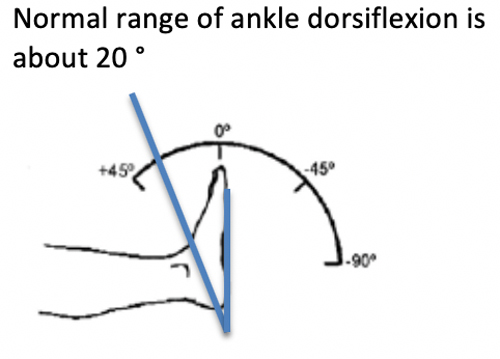
This is usually the most common joint to lose range of movement. Normal range is 20 degrees or more of dorsiflexion. Plantar grade is considered to be 0 degrees.
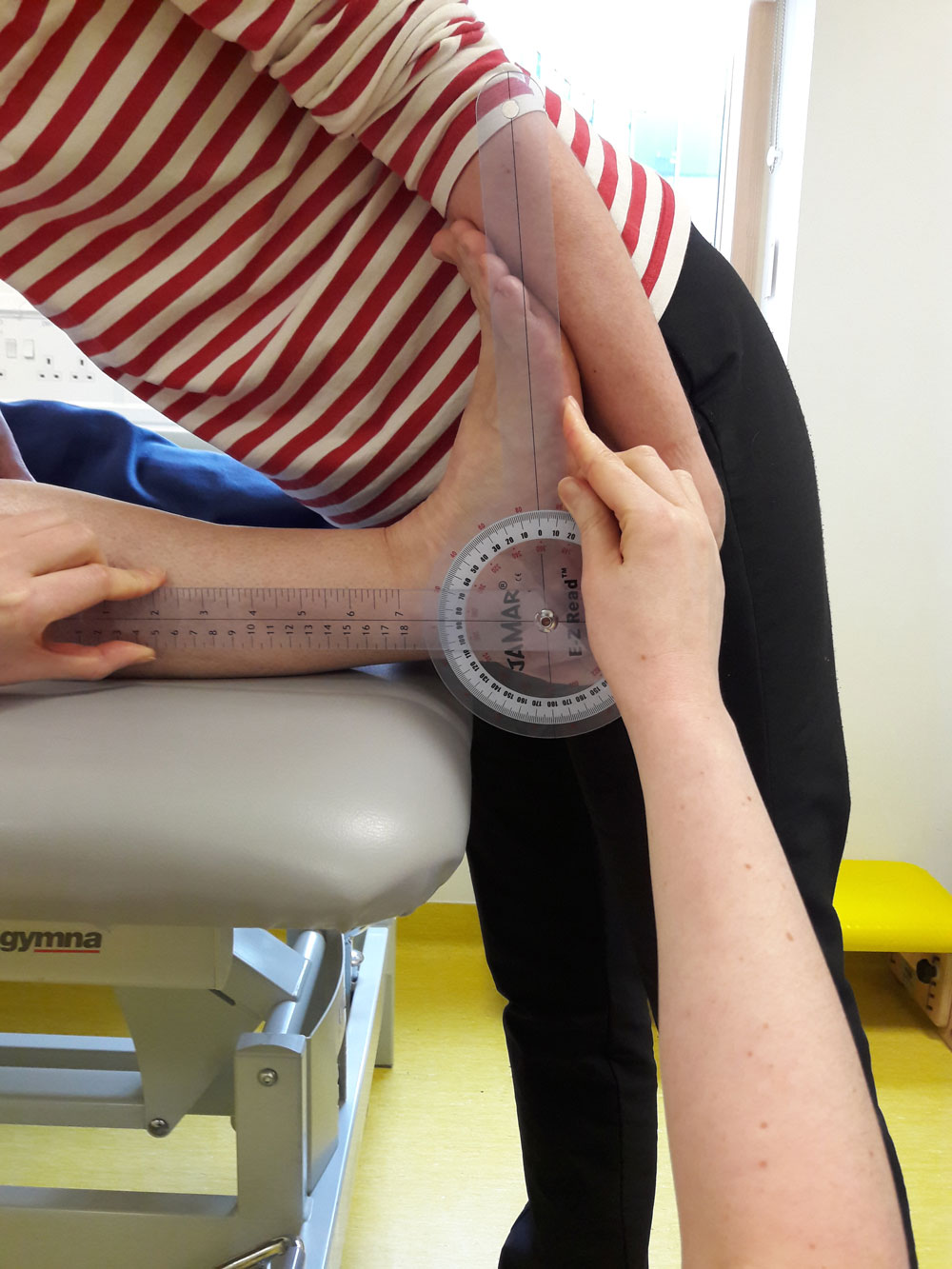
It is best to measure ankle range with the heel hanging over the edge of the bed. Use your thumb and forefinger to elongate the tendoachilles and use your hand and forearm to apply even pressure along the length of the foot. In this way you can use your body weight to increase pressure and hopefully range! It is hard to measure range when you are doing this. Use your eye to estimate the range and then ideally have someone maintain the stretch whilst you use a goniometer to measure.
Respiratory issues are not generally a problem in ambulant boys with Duchenne. However, as the disease progresses respiratory muscles are affected. In the non-ambulant phase, it is important to assess for symptoms of hypoventilation and establish a history of the severity of chest infections including frequency of chest infections, antibiotic use and any unplanned hospital admissions. These children may have respiratory equipment and an individualised respiratory care plan in place.
Forced Vital Capacity (FVC) is usually monitored from soon after diagnosis to get the boys used to this test. Some will never achieve a satisfactory test. As boys get older, a measure of their ability to cough effectively via Peak Cough Flow (PCF) (using a mask to achieve a good seal) is included in respiratory assessments. A falling FVC may prompt an overnight pulse oximetry trace to be done to check for symptoms of hypoventilation especially if the boy or family has mentioned poor sleep, nausea or headaches in the morning.
Contact a specialist neuromuscular team if you note a history of and increasing frequency of chest infections which may include:
- Unplanned hospital admissions for respiratory issues
- Increasing use of antibiotics
A tertiary assessment of Forced Vital Capacity (FVC) and Peak Cough Flow (PCF) will monitor respiratory capacity and a referral will be made to a Home Ventilation Team if required.
Pain is not usually a problem in this population in the ambulatory phase. However, pain in older boys, whether ambulant or not, must be taken seriously, as prolonged use of corticosteroids result in reduced bone density and fractures are not uncommon (although not always associated with pain).
Back pain if persistent, especially in non-ambulant children, may require an x-ray. A fall or knock may also require radiological review as a precaution. Many boys may not have severe pain associated with their fractures so even mild pain should be taken seriously.
*Becker muscular dystrophy (BMD): Pain can be a significant issue in this group. Painful cramps can be a problem in this population, so it is important to ask specifically about this.
Resources
- RCPCH https://learning.rcpch.ac.uk/courses/recognising-neuromuscular-disorders-a-practical-approach/
- APCP document on NMD
DMD Principles of Assessment: